
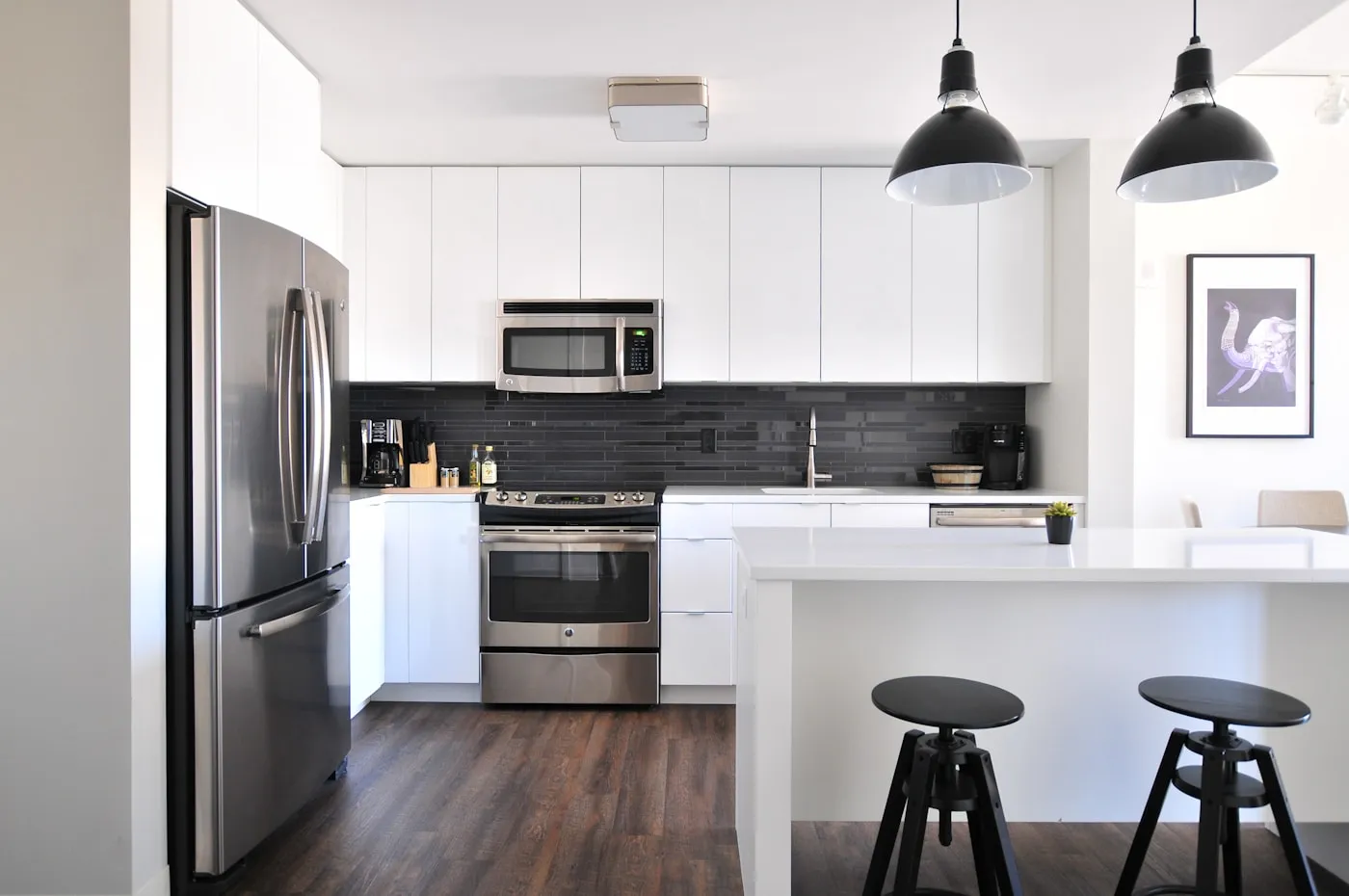
Cabinet Painting vs. Replacing: What a Tacoma Painter Wants You to Know
The short answer: repainting good existing cabinets costs roughly the same as buying low-end replacement cabinets — about $5,000 to $8,000 for a typical kitchen. The real difference is downtime. Replacing cabinets and countertops takes your kitchen out of service for around a month. Painting gets the boxes done in a couple of days and the whole job wrapped in about a week.
If your cabinets are structurally sound but dated, this is the decision in front of you. We've done enough cabinet painting to be straightforward about where each option wins.
On price, it's closer than you'd think
Actually the cost is very similar. If you're thinking about low-end Home Depot style cabinets — pre-finished, but probably not the best quality — us repainting some good cabinets is going to be about the cost of buying a lower quality cabinet.
That's the honest framing, and it cuts both ways. Painting is not the dramatic budget option against the cheapest possible replacement. Where it clearly wins is when your existing cabinets are better than what that budget would buy new — which, in a lot of older Pierce County homes with solid wood boxes, they are.
A small bathroom vanity is a different scale of job: as low as $1,200 for a quick in-and-out. Our full price guide is in what it costs to paint a house in Pierce County.
Where painting actually wins: your kitchen
If you're going to replace your cabinets and countertops, your kitchen is going to be out for a month or so. We are able to get in and out within about a week.
And within that week, the sequencing is designed to give you your kitchen back as early as possible:
Your kitchen itself, you're only out of it for a few days. And then you can get your kitchen back without doors or drawers. The drawers and door fronts we'll do still in the home, but you'll be able to at least live back in your kitchen right after that.
The cabinet boxes get primed, painted, and unmasked in the first couple of days. You're cooking again while the doors and drawer fronts cure on racks in another room. Compare that to a month of takeout and a sink in the garage.
The process, in detail
Cabinets are sprayed by default — brushed only if a customer specifically wants visible brush lines. Spraying inside an occupied house is the hard part, and it's where most of our equipment investment has gone.
The spray booth. We bring in a purpose-built booth, roughly 10×10:
I have a specialized spray booth I can set up that sucks all the air out of the booth, so that we get no overspray into the area around it, and then it filters and exhausts out of the home.
The same booth contains the sanding dust. This is why the job needs your kitchen plus one more decent-sized room — a living room, or part of the garage.
Day one. A paper trail goes down over every walking surface, and all the flooring in and around the kitchen is masked. Then every door, drawer, and knob comes off:
We're going to take down all the doors, door knobs and drawers, and label them, map them all out, so you know exactly where each one goes back.
The boxes, in place. The kitchen is sealed off tight. Cabinet interiors get taped — they aren't normally painted. Appliances are moved out where possible and masked in place where they aren't. Your dishes get pushed back a few inches and masked right where they sit.
Sanding uses a dust-extracting sander, which is the difference between a week of fine dust throughout your house and essentially none. Then:
- Oil primer, to bond properly into the wood
- Sand again — it's a sandable primer, and this pass takes out the imperfections
- Inspect for dings and nicks; caulk and fill anything found
- First coat of color, sprayed
- Dry, check, light sand
- Final coat
- De-mask — and you have your kitchen back
The doors and drawer fronts, in parallel. A second crew member runs the same process on the fronts: sanded inside and out, caulked, puttied, primed, inspected, coated. They live on a coat-hanger-style rack system, so a door goes into the booth, gets sprayed, and lifts straight out onto a drying rack without anyone touching a wet face.
The part most people get wrong: cure time
This is the single most important thing in this article, and it's where DIY cabinet jobs and rushed professional ones fail.
We try to have them drying, once they're fully done, for about two to three weeks before you put them back up. Paint usually takes about a month to fully cure. The more we can keep them out of the kitchen and fully hardened, the better quality the customer is going to have in the long run.
Paint that is dry is not paint that is cured. A cabinet door feels dry to the touch in hours. The finish keeps hardening for about a month. Reinstall on day three and the first fingernail, ring, or pan handle that catches an edge leaves a mark in a finish that would have shrugged it off two weeks later.
We'll accommodate impatience, with a warning:
If they're impatient — hey, we really want them up sooner — we can put them up within a few days. There's just a possibility that they still might be a little soft, and the wrong thing might get a chip in it. So you just have to be really careful.
If your cabinets chip early, this is usually why. Not the paint. The calendar.
What actually determines durability
Two things, and only one of them is the finish.
The cabinet itself. Solid wood behaves differently under a hard coating than particleboard or thermofoil does. This is worth an honest conversation before you commit — if the boxes are failing, paint won't fix that.
The product. We use two Sherwin-Williams lines for cabinets, chosen by job:
| Product | Where it's used | Trade-off |
|---|---|---|
| Emerald Urethane | Most kitchens — the default | Oil/water urethane hybrid, dries very hard and durable, and can be touched up later |
| Gallery Series | Small vanities and quick jobs | Dries harder and dramatically faster — a 36" vanity can be masked, sanded, primed and painted in about a day — but cannot be touched up with a brush or roller |
That touch-up distinction matters more than it sounds. Kitchens get lived in and eventually need a spot repair; Emerald allows that. Gallery's speed makes it the right answer for a one-day bathroom vanity where you're unlikely to be doing spot repairs.
Is it worth it?
After doing hundreds of these:
It's a great quick way to change the look of a cabinet. The before and after is always amazing — how much better they can look.
I rate it highly enough that when a customer's kitchen renovation had a set of solid cabinets headed for the dump, I didn't let them go. I kept them, refinished them, and put them in a rental.
On a larger scale, one job last year involved three different colors across an extensive set of built-ins, and the crew was on site for roughly a month painting millwork and trim.
It changes the whole look of the home.
Frequently asked questions
How much does it cost to paint kitchen cabinets?
Typically $5,000 to $8,000 depending on the size of the kitchen. Small bathroom vanities can be around $1,200.
Is it cheaper to paint or replace kitchen cabinets?
Painting good cabinets costs about the same as buying low-end replacement cabinets. Painting wins clearly on downtime — a week versus roughly a month — and on keeping better-quality existing boxes.
How long does cabinet painting take?
About a week on site. You get the kitchen back within a couple of days once the boxes are finished; the doors and drawer fronts continue curing on racks.
How long before I can put cabinet doors back on?
Two to three weeks is the recommendation. Paint takes about a month to fully cure. They can go back sooner if you need them, but the finish will still be soft and chips more easily.
Do you spray or brush cabinets?
Sprayed by default, inside a purpose-built booth that exhausts outside so there's no overspray in the home. Brushed only if a customer specifically wants brush lines.
Will there be dust and fumes through my house?
The booth exhausts outside and sanding is done with a dust-extracting sander, so dust stays contained. The paints used are low- or zero-VOC, so there's no meaningful odor concern for kids or pets.
Do you paint the inside of the cabinets?
Not normally — cabinet interiors are taped off. Ask if you want them included.
Wyatt & Sons paints kitchen cabinets and bathroom vanities throughout Tacoma, Gig Harbor, Federal Way, Puyallup, Auburn, Lakewood, and the surrounding Pierce County area — on site, in a sealed spray booth, with your kitchen back in days. Call (253) 680-9621.