
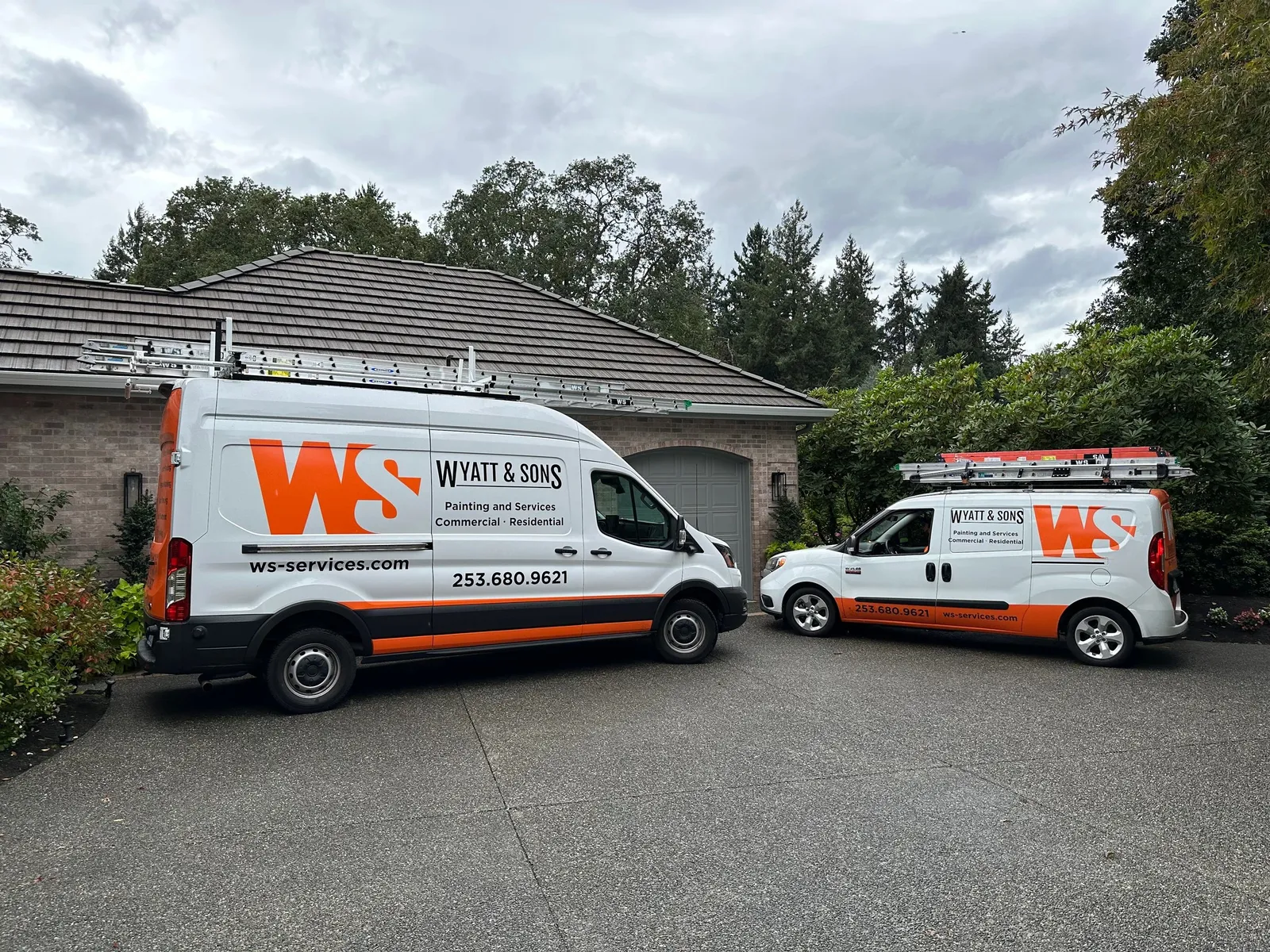
How to Choose a Painting Company in Pierce County: A 30-Year Contractor's Advice
The short answer: confirm the contractor is licensed, bonded, and insured through the Washington State L&I website, collect two to three quotes, and read the prep section of each one closely. A quote that lists "prep" as a single line is the clearest warning sign in the industry — detailed quotes protect you, vague ones leave room for surprise charges.
I've been painting for 30 years. I started at 12 in my parents' Seattle painting company, was running crews by 16 and bidding jobs by 18, spent 13 years building a painting business I eventually sold, and managed roughly 120 painters for the company that bought it before starting Wyatt & Sons here in Tacoma.
That's a long way of saying I've seen how painting companies bid — including the ways some of them bid to win rather than bid to be right. Here's what I tell people to look for.
Start with the four questions
Asked what I'd tell a family member hiring a painter in another state, my list is short:
- Are you licensed, bonded, and insured? In Washington, a contractor is legally required to carry a license and a bond to do this work. You can verify both yourself on the L&I website before anyone sets foot on your property.
- Get two to three quotes for any project you actually care about.
- Understand the warranty — what it covers, for how long, and what triggers it.
- Ask exactly what prep they're planning, and why.
That fourth one is where most of the real information lives.
The biggest red flag is a one-word prep line
If it's just simple and just says "prep" — big red flag. Ask detailed questions. What exactly are they planning on doing, and why?
A quote is a description of the work. If the description is thin, the work usually is too.
If the painter isn't putting detail in their quotes and it's just a few small line items or a bulk thing, they're going to miss something and they're not going to be covered.
And when prep is left vague, one of two things is happening. Either the contractor doesn't know enough about what the job requires to write it down — or they know exactly what they're leaving out. Neither one ends well for the homeowner.
Prep is not a formality on a Pacific Northwest exterior. It's washing with a bleach system that actually kills the mold and mildew rather than just rinsing it around, scraping every loose edge, cutting out and replacing split caulking, checking every water-intrusion point around doors and windows, and priming bare wood. Skip it and the paint looks fine for a season, then starts telling on you. Our exterior painting page lists every step so you can hold us to it.
How to compare two bids that are $3,000 apart
Most homeowners handle a price gap by assuming the expensive contractor is padding. My advice is to interrogate the low bid just as hard:
I would encourage them to ask both contractors — the low one and the high one — detailed questions, to dial down where these charges are coming from and why the low one's low. To see what they've missed.
This is exactly why an itemized quote is worth asking for. When both bids break out the work, the comparison becomes concrete: you can point at the two-thousand-dollar gap and get a real answer, like "I'm planning three extra days of prep on this house." Now you're not guessing about who's honest. You're looking at a specific difference in scope, and you can decide whether it's worth paying for.
Without line items, you're comparing two numbers and a feeling. For what the numbers themselves usually look like around here, see what it costs to paint a house in Pierce County.
The back-charge trap
This is the part of the industry most contractors won't explain to you:
You'll have a painting contractor come in, do a bid, and then mid-job they'll say something wasn't part of the bid. And then that's where they try to back charge. In commercial it happens all the time — that's a big way they make money. They low bid to get in, and they will back charge to actually make their profit.
The low number that won the job was never the real number. It was the entry fee. The profit arrives later, in change orders, once your house is half-painted and switching contractors is no longer a realistic option.
The defense is the same as everything else here: a quote detailed enough that "that wasn't in the bid" is a checkable claim rather than an argument you're going to lose. We don't work that way, in commercial or residential.
Why the cheapest bid is sometimes the most expensive one
One of our first significant jobs was for a well-known Tacoma contractor, in a new brick building they had just finished. They had already fired their original painter over the quality of the work.
Our crew spent two and a half to three months repainting walls and correcting surfaces that hadn't been prepped properly the first time. That entire project — months of labor — existed only because someone had already been paid to do it once.
That's the arithmetic of a cheap bid when it goes wrong. You don't save the difference. You pay the low bid, and then you pay someone else the real price to redo it.
To be fair, I don't think price alone tells you much:
Sometimes those little guys are good guys. You can get a deal. It all depends.
The point isn't to always hire the highest bidder. It's to understand why a number is what it is before you sign it.
What actually makes one quote higher than another
When a painting company costs more, ask where the money goes. For us, it's more prep hours, better paint, and how we pay our crew.
I give full benefits for my guys. I'm trying to pay pretty high rates and give them a standard of living that they can enjoy as they serve our customers. A lot of other cheaper companies don't do that. And that costs some money — it has to come from somewhere.
We tend not to be the cheapest in town, and it's usually because of the quality of work we give and the caliber of the people doing it.
There's also a structural detail worth knowing about, because it changes what a crew is motivated to do. We run profit sharing: when a job comes in under its estimated hours, the surplus goes into a pool the crew shares. Callbacks come out of that same pool. The people holding the sprayer have a direct financial stake in the work not needing to be redone. More on how we think about that is on our about page.
Questions about the warranty
We warranty our labor for one year — anything missed, or anything that failed because of how the work was done. The paint itself carries a separate manufacturer warranty, and most of the products we use are warrantied for life.
Worth noting what 30 years of paint warranties looks like in practice:
I've never, in my 30 years of being in the industry, had to use a warranty for a paint.
Paint failures are almost never the paint. They're the preparation underneath it.
The real-world callback, when it happens, is small: a spot that's only visible from one odd angle through a particular window. Somebody notices it a few weeks later, calls, and the crew comes back and touches it up.
Frequently asked questions
How do I check if a painting contractor is licensed in Washington?
Both the license and the bond are verifiable on the Washington State Department of Labor & Industries "Verify a Contractor" page. Every contractor doing this work in Washington is required to carry both. It takes about two minutes and it's the first thing to check.
How many quotes should I get?
Two to three for any project of real size. Fewer and you have no basis for comparison; more and you're mostly spending your own time.
What should be itemized in a painting quote?
The prep specifically — washing method, scraping, caulking, priming — plus the products being used, the number of coats, exactly which surfaces are included, and the warranty terms. If prep is one word, ask for it in writing broken out.
Is the most expensive painting quote always the best?
No. A smaller, cheaper contractor can be a genuinely good deal. What matters is understanding what each number includes. A high bid with vague scope is no better than a low one.
What's a normal warranty for exterior painting?
One year on labor is the standard we offer, alongside the manufacturer's warranty on the paint itself, which is frequently lifetime.
Wyatt & Sons provides commercial and residential painting throughout Tacoma, Gig Harbor, Federal Way, Puyallup, Auburn, Lakewood, and the surrounding Pierce County area. Every quote we write itemizes the prep, the products, and the warranty — so you can compare it honestly against anyone else's. Call (253) 680-9621 for an estimate.