
How to Maintain Exterior Paint in Western Washington: A Year-Round Calendar for Pierce, King, Thurston, Kitsap, and Mason County Homes
Exterior paint maintenance in Western Washington comes down to four recurring jobs: a bleach wash every two years, a caulking and flashing check every fall, clean gutters before the rains, and repainting the one or two most weather-beaten walls at the midpoint of a seven-to-ten-year cycle. Do those and a Pierce County paint job reaches year ten. Skip them and it fails at year three.
Most of what gets written about "protecting your home from the Pacific Northwest weather" treats rain as the enemy and paint as armor. Thirty years of painting houses from Tacoma up to Tukwila and down to Olympia has taught me it's closer to the opposite: rain is mostly harmless to a sound paint film, and what actually eats a house is the biology that grows when siding never dries, plus the water that gets behind the paint through failed caulking. This guide is the calendar we'd hand a homeowner who wants to stop repainting every five years.
The numbers that frame exterior maintenance here
- 154.9 days a year with measurable rain in Tacoma, on 40.81 inches total — not extreme rainfall, but siding that stays damp for months at a time.
- 7 to 10 years — the realistic life of an exterior paint job in the Puget Sound region when it's maintained.
- 2 years — how often the house should be washed with a bleach solution, not just rinsed.
- 35°F — the temperature above which exterior paint can go on, which makes our painting season close to year-round.
- 946,288 people in Pierce County (2025 estimate), most of them in wood-sided homes doing this math whether they know it or not.
What exterior paint maintenance actually is
Paint is a film. It sheds water, blocks UV, and keeps the wood underneath from soaking and drying in cycles that open up joints. Maintenance is everything you do to keep that film continuous and adhered: killing the growth that lifts it, sealing the seams where water bypasses it, and refreshing the sections that wear out before the rest.
It is not washing the house because it looks dirty, and it is not repainting on a fixed schedule because a calendar said so. A well-maintained house on a shady lot in University Place and a neglected one in full sun in Puyallup can be the same age and need completely different work. The film tells you what it needs; the job is learning to read it.
Three components, in plain terms:
- Biological control. Moss, mildew, and algae on the surface — killed, not just rinsed.
- Water management. Caulking, flashing, and gutters, so water runs off the film instead of behind it.
- Selective recoating. The south and west walls, the sills, the fascia — the parts that fail first get paint before the whole house needs it.
If you want the full-repaint version of this — every one of the fourteen steps — read what exterior painting in Tacoma actually involves.
How the calendar works, season by season
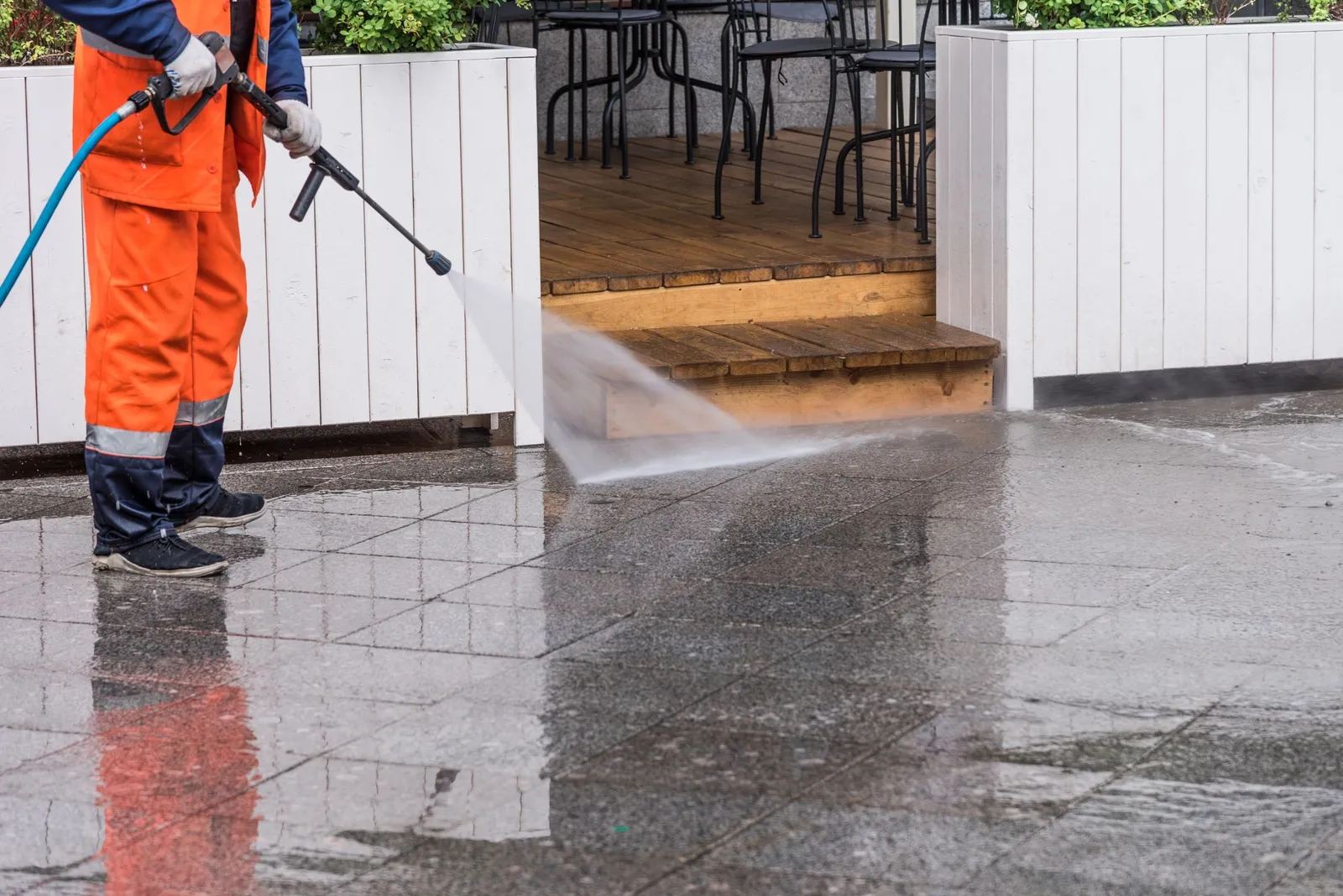
Late winter to spring (February–April): wash. This is the bleach-wash window. A bleach solution kills mold and mildew at the root; a plain pressure rinse just spreads it around and can drive water into the siding. Follow with a full rinse. Every two years is the interval — more often on heavily shaded north walls, under big firs, or anywhere you can see green. Our bleach-wash pressure washing is the same system we use as paint prep, because it is paint prep.
Late spring through fall (May–October): paint. Anything above 35 degrees and dry is paintable, and modern exterior formulas tolerate rain shortly after they cure. This is when the mid-cycle touch-up happens: at year four or five of a paint job, repaint the one or two walls that face the weather hardest. A day or two of work buys years on the whole house. Staining decks and fences is the exception — stain is far more weather-sensitive, so it gets the dry months only.
Early fall (September–October): the caulking and flashing audit. Walk the house before the rains settle in. Any caulking that's split, shrunk, or pulled away from a window or corner board gets cut out and reapplied. Check the flashing above windows and doors and where roofs meet walls. The number one problem I find on Tacoma and Federal Way houses is rot — and it almost always traces back to bad caulking or missing flashing, not to paint.
Fall (October–November): gutters and roof. When gutters fill with needles and leaves, water backs up into the eaves and the eaves rot out, taking the fascia paint with them. Clean them before the November rains. This is also the window for roof moss treatment and gutter cleaning — a zinc-based treatment kills roof moss at the root, and a soft-wash roof cleaning does it without stripping shingles or voiding a warranty.
Winter (December–January): look. Walk the house on a dry day. Chalking on the sunny side, green on the shady side, hairline gaps at the trim, soft spots at the bottom of corner boards. You are not fixing anything in January. You are writing the list for the spring wash and the summer touch-up.
Why rain isn't what kills your paint
Homeowners assume the problem is water hitting the house. The reality is that a sound paint film sheds water all day long. What deteriorates a Western Washington house is what the wet enables:
Moss and mildew do the most damage. On the shaded side of a house, siding stays damp for weeks. Mildew colonizes the film; moss takes every ledge. If the last painter rinsed instead of washing with bleach, that growth is now embedded between the layers of paint, and it lifts the new coat from underneath. The peeling you see in sheets on a north wall two years after a repaint is biology, not weather.
Poor prep lets water behind the film. Skipped caulking, unprimed bare wood, a rinse instead of a wash — each one leaves a path for moisture to get under the paint, where it soaks the wood, swells it, and pops the film off from the inside. That is the second biggest killer, and it is entirely the painter's doing.
Sun matters more than salt. Waterfront homeowners in Gig Harbor and along Kitsap County shorelines worry about salt air. Salt does affect paint, but sun exposure matters more: heavy sun dries the film out faster, and some pigments fade faster than others — the deep charcoals and navies everyone is choosing right now go first. Heavy shade brings the opposite problem: moisture, mold, and moss. Read your exposure before you read your zip code.
Where this calendar applies — and where it doesn't
It applies to painted wood, fiber-cement, and previously painted vinyl siding on houses in the Puget Sound lowlands — the Tacoma, Federal Way, Auburn, Puyallup, Lakewood, and Gig Harbor homes we work on, and the same climate band up through King County and down into Thurston and Mason.
It does not apply cleanly to two situations. Very old siding with many paint layers sometimes shouldn't get the highest-grade paint at all: a premium coating can bite in hard enough to pull the old paint off with it, and a lesser, more breathable product is the right call. And lead paint — likely on anything built before 1978 — changes every step, because scraping and washing have to be done under certified containment, collecting every flake so it doesn't end up in your soil. A hundred-year-old house with brand-new siding gets the premium product; the same house with its original siding may need something else. That decision is worth a conversation before anyone buys paint.
Symptom to action: a decision matrix
| What you see | What it means | What to do, and when |
|---|---|---|
| Green or black film on shaded walls | Mildew and algae living on the paint | Bleach wash and rinse this spring; repeat every 2 years |
| Paint peeling in sheets on the north side | Growth or moisture trapped between coats | Wash, scrape to sound paint, peel-bond primer, recoat that wall |
| Chalky, faded south or west wall | UV breaking down the binder | Mid-cycle repaint of that wall with Emerald or Duration |
| Gaps or cracks at window trim and corner boards | Caulking failed; water path open | Cut out and re-caulk before fall rains — don't wait for a repaint |
| Soft or discolored fascia under the gutter line | Gutters backing up into the eaves | Clean gutters now, then repair and prime the wood |
| Fine cracking across the whole house, 8–10 years in | The film has reached end of life | Plan a full exterior repaint |
Most homeowners should default to the first row: wash on schedule and most of the others never appear. The row people get wrong most often is the fourth — treating failed caulking as a cosmetic thing to fix "when we repaint," which is how a $200 caulking afternoon becomes a $3,000 rot repair.
The Tacoma Narrows lesson, and where exterior coatings are heading
The most famous structure in Pierce County failed in 1940 for reasons that had nothing to do with the strength of its steel — the Tacoma Narrows Bridge tore itself apart in a forty-mile-an-hour wind because of how it was designed to move, not what it was made of. It's the local reminder I come back to: the material is rarely the problem. How the system handles water and movement is.
Coatings have gotten dramatically better at that. Twenty years ago exterior paint was oil or a stiff acrylic, and a wet year meant a short life. Today's 100% acrylics — Sherwin-Williams Duration as our standard body paint, Emerald on deep colors for fade resistance — flex with the siding and shrug off rain within hours of going on. Nearly everything we use is low- or no-VOC now; the headache-in-the-office complaint of the 1990s is gone. And the next step is already on a couple of our customers' houses: self-cleaning exterior formulas like Sherwin-Williams Rain Refresh, which use the rain itself to shed dirt and slow the biological growth this whole article is about. Better paint hasn't changed the calendar. It has made following the calendar pay off longer.
Three principles that hold for Western Washington exteriors
- Kill the growth, don't just move it. A rinse without bleach leaves mildew between the layers, and the next paint job peels from underneath.
- Every two years, wash; every four or five, repaint the worst wall. Two small jobs push a seven-year paint job to ten.
- Fix caulking the season you find it.
Frequently asked questions
Frequently asked questions
How often should I pressure wash my house in Western Washington?
Every two years as a baseline, and more often on heavily shaded walls or under large trees. The wash has to include a bleach solution that kills mold and mildew, followed by a full rinse. A pressure-only rinse spreads the growth and can force water into the siding.
How long does exterior paint last in the Puget Sound area?
Seven to ten years for a properly prepped job, and maintenance decides which end. Washing on schedule and repainting the one or two hardest-hit walls at the midpoint keeps the whole house at ten. Poor prep on the original job — skipped bleach, thin caulking, no primer on bare wood — shortens it to three or four.
Is salt air from Puget Sound bad for exterior paint?
It has an effect, but sun exposure and shade matter more. South- and west-facing walls fade and chalk from UV; north-facing and heavily shaded walls grow mildew and moss. A waterfront house in Gig Harbor gets a coastal-rated coating, but the maintenance plan is still driven by which walls see sun and which stay damp.
Why do my eaves and fascia keep rotting even though the paint looks fine?
Almost always gutters. When they fill with needles and leaves, water backs up into the eaves and soaks the wood from behind, where paint can't help. Clean gutters before the fall rains, check that downspouts drain away from the foundation, and prime any bare wood you expose during the repair.
Can I do this maintenance myself?
The winter walk-around, yes — and clearing gutters if you're comfortable on a ladder. Bleach washing and caulking are doable but time-consuming, and prep is where DIY jobs usually go wrong. Mid-cycle repaints are where hiring pays off: cutting clean straight lines on trim is the skill homeowners underestimate most.